
[DES!GN TALK!] A Quiet Interpretation of Korean Heritage 02

The Guest Room as a Place of Quiet Rest
In the previous article, I introduced Sadamjae through its relationship with the landscape, exterior, lobby, restaurant, and public spaces. The project began with the intention of creating a quiet interpretation of Korean design — not through decorative references, but through restraint, proportion, material calmness, and hospitality.
In this article, I would like to move deeper into the guest rooms. For a small high-end stay, the guest room is not simply a private area for sleeping. It is the most intimate part of the experience, where the guest finally meets the true atmosphere of the place.
At Sadamjae, the guest room was designed as a space where the body can slow down. The goal was not to create a room filled with visual stimulation, but to create a calm environment where light, view, material, and silence could quietly support rest.

A Room That Receives the Landscape
One of the most important questions in designing the guest rooms was how the room should relate to the outside landscape. In a place like Mungyeong, nature is not a background image. It is part of the experience of staying.

Rather than treating the window as a simple opening, the guest room was planned as a frame for the landscape. The view is not meant to be consumed quickly. It is something that slowly changes through the day — with morning light, afternoon shadows, evening calmness, and seasonal atmosphere.
This relationship between interior and exterior is one of the quietest but most important qualities of Sadamjae. The room does not try to dominate the scenery. Instead, it allows the guest to notice it more carefully.

The Structure of Rest


A guest room should support the natural rhythm of the body. Entering, placing one’s belongings, washing, resting, sitting, looking outside, sleeping, and waking up are all small actions, but together they define the quality of the stay.
At Sadamjae, the guest room was considered through this sequence. The space was not designed as a single photogenic scene, but as a series of quiet moments. The movement from entrance to bed, from bed to bathroom, from bathroom back to the resting area, and from the interior toward the view was carefully considered.
This kind of planning is especially important in a small stay. When the scale is intimate, every distance, proportion, and transition becomes more noticeable. A room feels comfortable not because it is large, but because the body understands how to move within it.

Light as a Material
Light plays an essential role in the atmosphere of Sadamjae. Rather than using light only to brighten the room, the design treats light as a material that shapes time.
Natural light enters the room gently, revealing the texture of materials and the depth of the space. As the day changes, the room also changes. This allows the guest to feel time passing without needing any strong visual event.
Artificial lighting was also considered to support a slower mood. In a high-end stay, lighting should not simply make the room look luxurious. It should help the guest feel comfortable at different moments — arriving, resting, bathing, reading, preparing for sleep, and waking up again.
The quiet control of light is one of the ways Sadamjae creates emotional depth without excessive decoration.

Materials That Do Not Demand Attention

The material palette of the guest rooms was approached with restraint. The intention was not to create a space that immediately impresses through expensive finishes, but to create an atmosphere that feels composed and lasting.
In hospitality design, materials are not only visual elements. They are touched, heard, and experienced through the body. The surface near the bed, the floor under bare feet, the wall that receives light, the texture around the bathroom — each material contributes to the guest’s sense of comfort.
At Sadamjae, the materials were selected to remain quiet. They do not demand attention, but they support the mood of the room. This is a different kind of luxury: one that is not loud, but precise.

The Bathroom as Part of the Stay
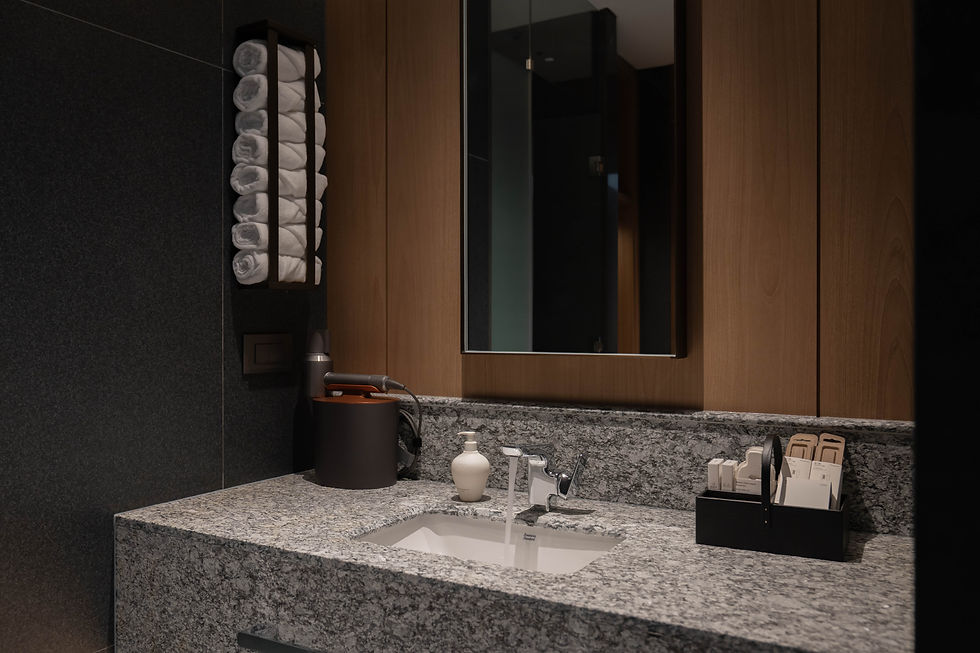
In many accommodations, the bathroom is treated as a purely functional space. At Sadamjae, however, it was considered as part of the overall rhythm of rest.
Bathing is not separate from staying. It is one of the most important moments when the body relaxes and resets. The bathroom therefore needed to feel connected to the atmosphere of the room, rather than detached from it.
The relationship between washing, bathing, dressing, and resting was considered as one continuous sequence. The bathroom should not interrupt the calmness of the guest room. It should extend it.
This is especially important in a high-end stay. True comfort is often found in the transitions between functions — not only in the bed, not only in the bath, but in the way each moment connects to the next.
A Contemporary Korean Sense of Quietness
The guest rooms of Sadamjae do not express Korean design through obvious motifs. There are no excessive symbols or decorative gestures. Instead, the Korean sensibility appears through proportion, emptiness, restrained materiality, and the relationship between the room and nature.
This was important to me. I wanted the space to feel rooted in Korea without becoming nostalgic or theatrical. The design needed to be contemporary, but still carry a quiet emotional depth.
In that sense, the guest room becomes a place where Korean design is reinterpreted through atmosphere rather than image. It is not about showing tradition directly. It is about carrying the attitude of calmness, balance, and respect for nature into a modern hospitality space.

Designing for a Slower Body
Ultimately, the guest room at Sadamjae is designed for a slower body. It is a space where the guest can put down the pace of travel, become aware of light and silence, and return to a more settled state.
For me, this is one of the most important roles of hospitality design. A good room should not only provide convenience. It should change the condition of the person staying inside it. It should help the guest breathe differently, move more slowly, and remember the place through a feeling rather than a single image.
Sadamjae’s guest rooms were designed with this belief. They are quiet, but not empty. Refined, but not distant. Contemporary, but still connected to the landscape and emotional character of Korea.
In the next article, I will look more closely at the details that deepen the experience of staying — furniture, lighting, material transitions, and the small design decisions that make the room feel more personal and complete.
![[DES!GN TALK!] A Quiet Interpretation of Korean Heritage 03](https://static.wixstatic.com/media/8c154a_b3f94103964c4d6cbf6ed760d9b28694~mv2.jpg/v1/fill/w_980,h_653,al_c,q_85,usm_0.66_1.00_0.01,enc_avif,quality_auto/8c154a_b3f94103964c4d6cbf6ed760d9b28694~mv2.jpg)
![[DES!GN TALK!] A Quiet Interpretation of Korean Heritage 01](https://static.wixstatic.com/media/8c154a_18e4efa113ff46159b103f9fed3d0bf7~mv2.jpg/v1/fill/w_980,h_551,al_c,q_85,usm_0.66_1.00_0.01,enc_avif,quality_auto/8c154a_18e4efa113ff46159b103f9fed3d0bf7~mv2.jpg)
![[DES!GN TALK!] SHIBUYA SAUNAS: Brand Sells Recovery in the City 03](https://static.wixstatic.com/media/8c154a_95dee9f955cb4e458729870763002cea~mv2.png/v1/fill/w_968,h_639,al_c,q_90,enc_avif,quality_auto/8c154a_95dee9f955cb4e458729870763002cea~mv2.png)
댓글